

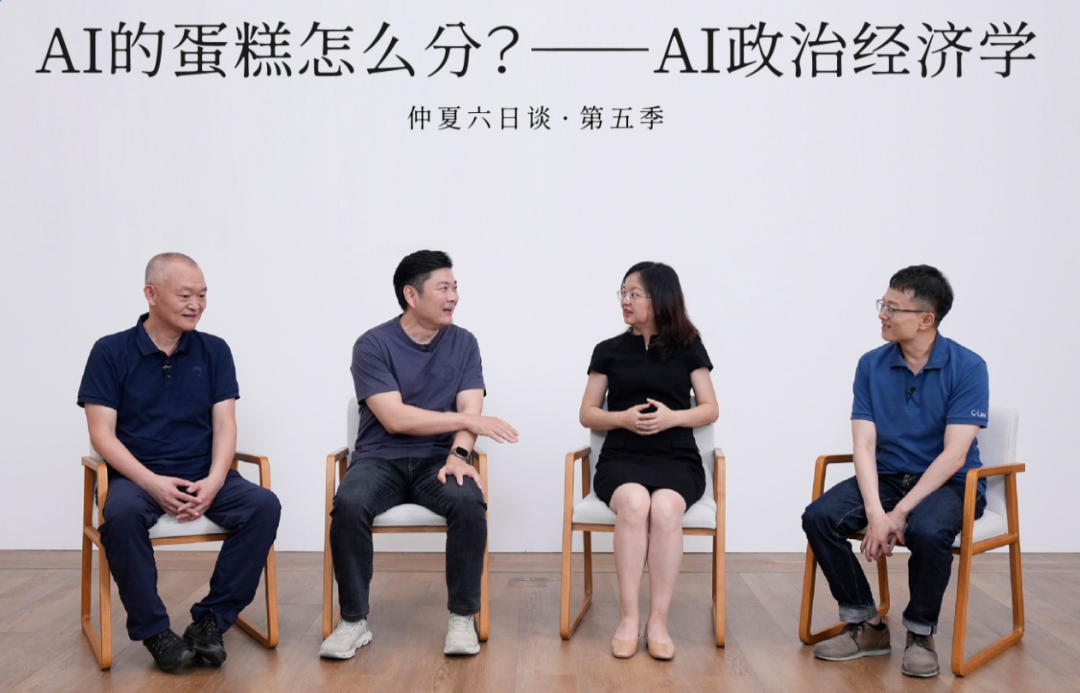
Professor Zhaoli Meng, Associate Director of the Center for Technology and Business Ecosystem (CTBE), recently participated in the third session of Midsummer Six Talks 2026, hosted by Tencent Research Institute. She joined Zipeng Zhou, Executive Director of CICC, Jian Yang, Chief Advisor of Tencent Research Institute, and Gang Li, Deputy Director of Tencent Research Institute, for a discussion titled“The Political Economy of AI: Who Wins and Who Loses?”
The panel explored how artificial intelligence is reshaping wealth creation, value distribution, industrial structures, and social mobility. Discussions focused on three key questions: whether AI represents a fundamentally different technological revolution, whether the economics of AI are sustainable, and how AI may transform employment, fairness, and the future role of human work.
During the discussion, Professor Meng highlighted that AI is accelerating the concentration of innovation resources, talent, and capital around a single technological trajectory. While previous waves of digital innovation have already concentrated significant global attention and investment within the information technology sector, AI may further amplify this trend, creating unprecedented “gravitational force” across industries and societies.
Professor Meng also emphasized the importance of examining value distribution across the AI ecosystem. While AI offers enormous opportunities for productivity and innovation, she noted that excessive dependence on centralized model providers could raise concerns regarding data sovereignty, knowledge ownership, and organizational autonomy. In this context, open-source ecosystems and local deployment capabilities may play an important role in enabling broader and more sustainable innovation.
Addressing the future of work, Professor Meng introduced the concept of the “ladder-removal effect,” suggesting that AI may significantly reshape traditional career development pathways in professional services and knowledge-intensive industries. As entry-level and intermediate tasks become increasingly automated, organizations may need to rethink talent development, succession planning, and long-term capability building.
Despite differing perspectives on AI’s long-term social impact, the panel shared a common conclusion: individuals and organizations should remain actively engaged with technological change. Rather than focusing solely on optimistic or pessimistic narratives, participants encouraged continuous learning and practical experimentation with AI in daily work and life.
Full transcript can be accessed via: https://mp.weixin.qq.com/s/FxaTUCNX2CvyIdIjxIlkiQ